
Targets harmful bacteria.
Leaves the good ones alone.
Biome Shield is a fluoride-free toothpaste formulated with paeoniflorin and quercetin — two studied natural actives that help target the harmful bacteria below the gumline.
Start with 3 tubes →Shop the bundles.
One formulation, three sizes. The per-tube price falls sharply as the bundle grows, and shipping is free on every order.


 Most popular
 Lowest per tube
Most toothpaste is designed to make a mouth feel clean.
That isn’t an accusation. It’s the brief the whole category has worked to for about sixty years. Foam, mint, whitening — the three things a person can actually perceive while brushing, and therefore the three things that sell tubes.
A mouth hosts a large bacterial community. That’s normal and unavoidable — nobody has a sterile mouth and nobody should want one. But a small number of species within that community are harmful, and they don’t live where the brush goes.
They colonise below the gumline, in the narrow space between tooth and gum, sheltered inside biofilm — a structure that physically protects whatever is living in it.
And here’s the part that overturns the usual advice. The best-studied of those species does its damage while present in low numbers.1 Its effect is out of proportion to its abundance, because it interferes with the immune response in the surrounding tissue rather than simply outnumbering everything else. The local community shifts out of balance. The tissue stays inflamed. Inflamed gum tissue bleeds when it’s brushed.
So this was never a question of quantity, and it was never a question of effort.
1Porphyromonas gingivalis is described in the published literature as a low-abundance "keystone" species — one whose influence on periodontal tissue is disproportionate to its numbers because it acts on the host immune response rather than by sheer population. A description of published research, not a statement about any individual's outcome.
Sixty seconds,
tonight.
Most people have never run this check. They brush, they rinse, they get on with their day, and they read the absence of pain as the presence of health.
Healthy gum tissue tends not to bleed from gentle contact. Inflamed tissue frequently does. This is an observation, not a diagnosis — plenty of things can produce it, and only a dentist can tell you what’s actually happening in your mouth.
But if the floss comes out marked, and it does so consistently, in the same place, week after week — that’s worth raising with someone qualified rather than explaining away for another six months.
- Take a length of floss. Any floss you have. This isn’t about the floss.
- Reach the back molars. The ones furthest from the mirror — which get least attention when you’re in a hurry. Slide just below the gumline, curve against the tooth, and draw it out.
- Now look at it. Not at the mirror. At the floss.

Paeoniflorin, from peony root — the first of the two actives.
The problem was never intensity. It was targeting.
The intuitive answer is to kill the bacteria, and the category tried that. Triclosan was the best known of them, standard in mainstream toothpaste for years before regulators reassessed it and manufacturers moved away.2
But a mouth isn’t a surface to be sterilised. It hosts several hundred bacterial species, and the great majority are either neutral or useful — breaking down food, occupying territory that would otherwise be colonised by something less friendly, forming part of your immune system’s first line.
A broad antibacterial doesn’t distinguish. It reduces the harmful population and the protective one in the same pass. The niche reopens, something moves back in, and there’s no guarantee it’s what you wanted.
Schematic. It illustrates the difference in approach, not measured values.
Reduces the harmful population and the protective one in the same pass. The niche reopens — and there’s no guarantee what moves back in is what you wanted.
Targets the species doing the damage and leaves the protective community in place. The goal was never a stronger antibacterial. It was a more precise one.
A practising dentist is running an ongoing clinical evaluation in periodontally involved patients. Across the first ten documented cases the dentist reported a reduction in bleeding on probing in most patients, with residual bleeding concentrated in posterior sites. A further twenty to thirty cases are in progress.
How the practitioner programme works →2Triclosan was a common antibacterial agent in oral-care and consumer products for years before regulatory reassessment led manufacturers to move away from it.


Formulated by a professor of orthodontics.
Professor A-Bakr M. Rabie trained at Northwestern University — a Certificate of Orthodontics, an MSc and a PhD — and then spent nineteen years as Professor of Orthodontics at the University of Hong Kong, where he was Director of its Postgraduate Orthodontics Program and Chairman of its Faculty Board of Orthodontics. Globally published.
His career has been the science of the mouth rather than the marketing of it — which turns out to matter in a category where almost every product is developed the other way round: marketing first, formulation to match.
Across those years he kept arriving at the same blind spot in what his patients were using. So he built the thing he couldn’t buy — and he built it with his son, Adam. It’s a family company, not a brand extension.
Ingredients with integrity.
Professor Rabie’s response wasn’t to build a better abrasive. It was to formulate around two plant-derived natural active ingredients, each selected for published work on exactly this problem.
A naturally occurring compound from the root of the peony. It sits at the centre of Professor Rabie's own research into plant-derived actives.

A flavonoid found widely in fruits and vegetables, and among the more extensively studied natural compounds in the literature — including peer-reviewed work on the species most associated with periodontal disease.

The problem has two halves — a harmful species doing damage, and an inflammatory response that won’t settle. There’s published research behind each active against one of those halves.
The aim was never to sterilise a mouth — which is why it took someone who had spent nineteen years studying the biology rather than the marketing to arrive at something narrower.
3Paeoniflorin is a naturally occurring compound from the root of the peony, Paeonia lactiflora, and a focus of Professor Rabie's published research into plant-derived actives. Described as studied, not proven.
4Quercetin is a plant flavonoid found widely in fruits and vegetables; peer-reviewed work has examined its activity against Porphyromonas gingivalis and Aggregatibacter actinomycetemcomitans, species associated with periodontal disease. Studied, not a treatment claim.

Biome Shield Toothpaste
You use it precisely the way you use whatever is in your bathroom now — twice a day, on a normal brush, and it tastes like toothpaste rather than like medicine. That was deliberate. A paste people dread using is a paste people stop using.
Because the formulation started from the biology rather than from the sensory cues, it simply didn’t need the ingredients most tubes carry to generate lather. SLS-free is a consequence of the design, not a decision taken afterwards.
Gum health isn’t a one-tube project.
Sold direct, in bundles, because the per-tube price falls sharply as the bundle grows.
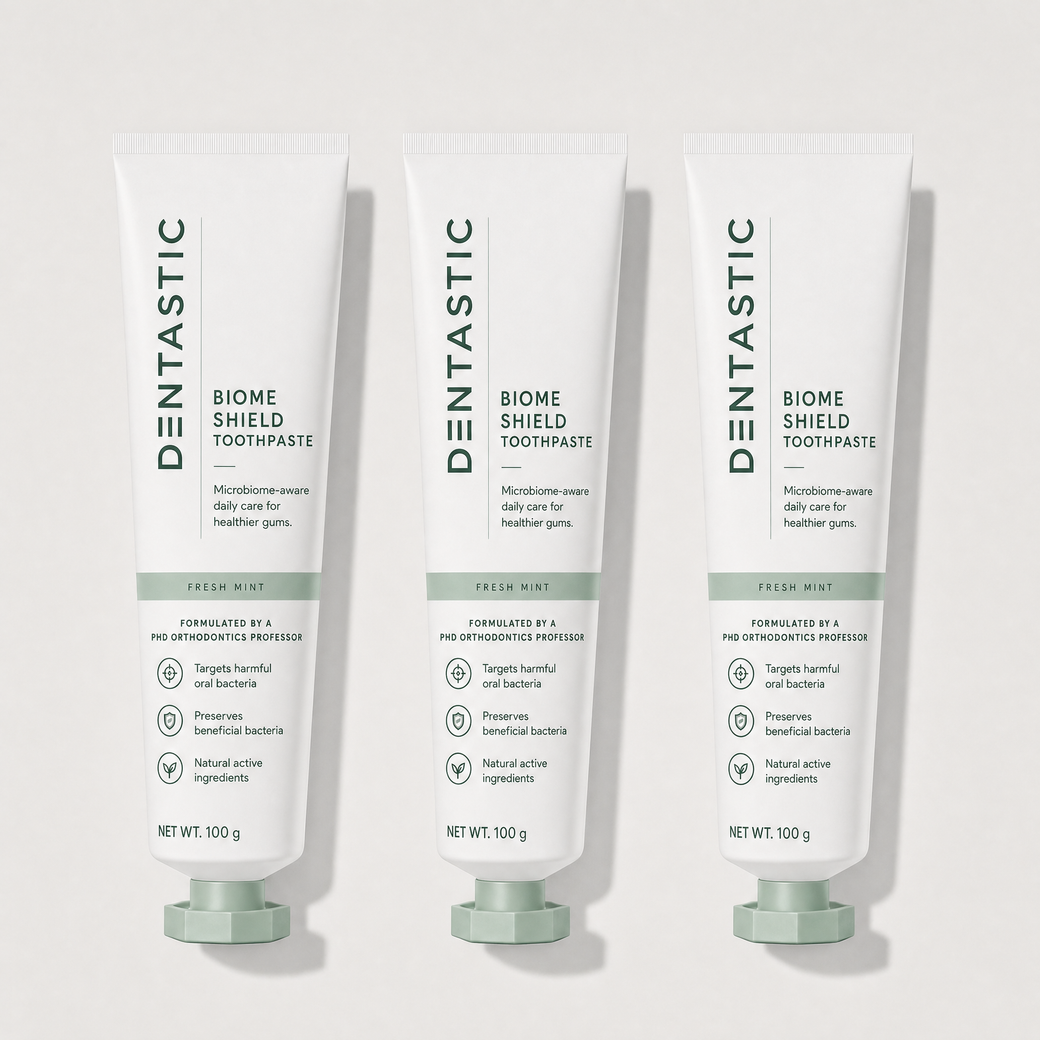
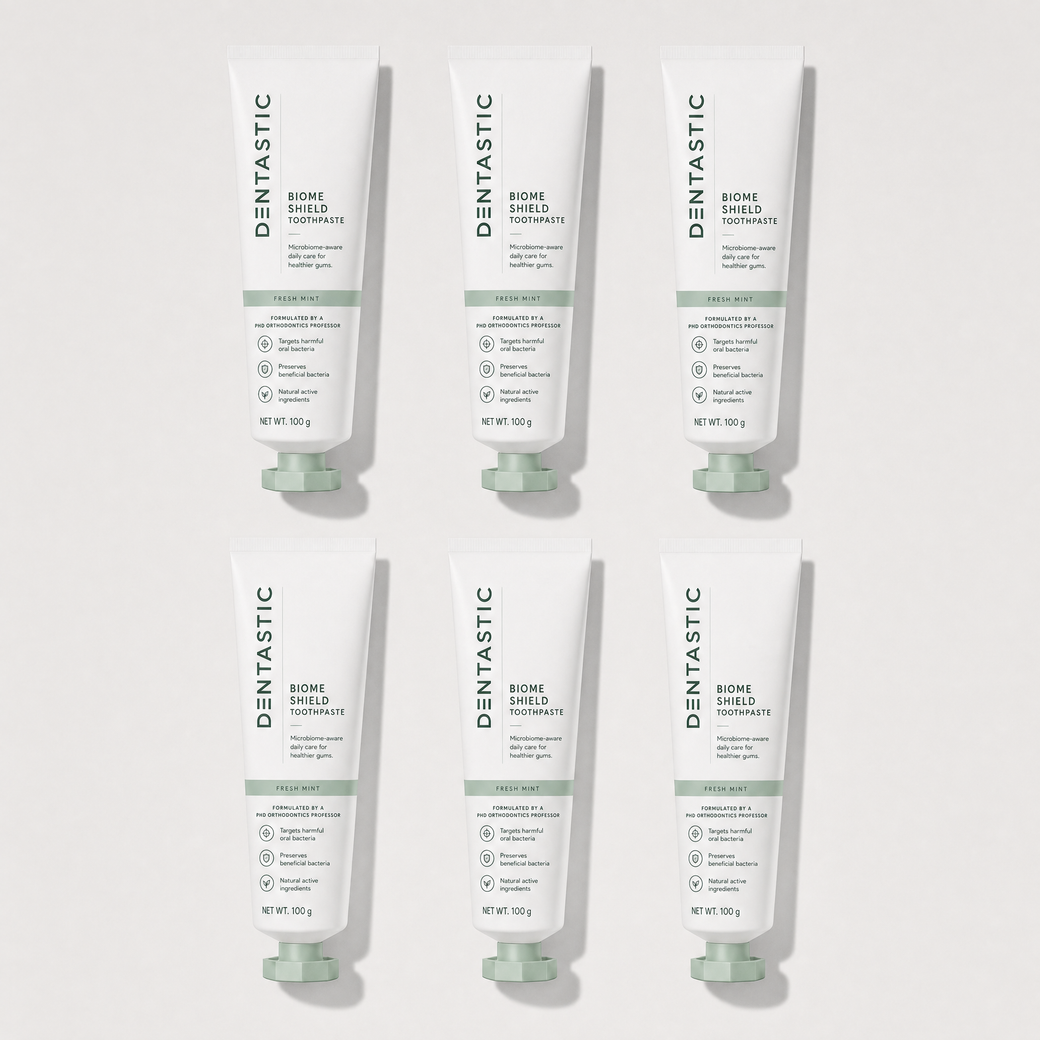
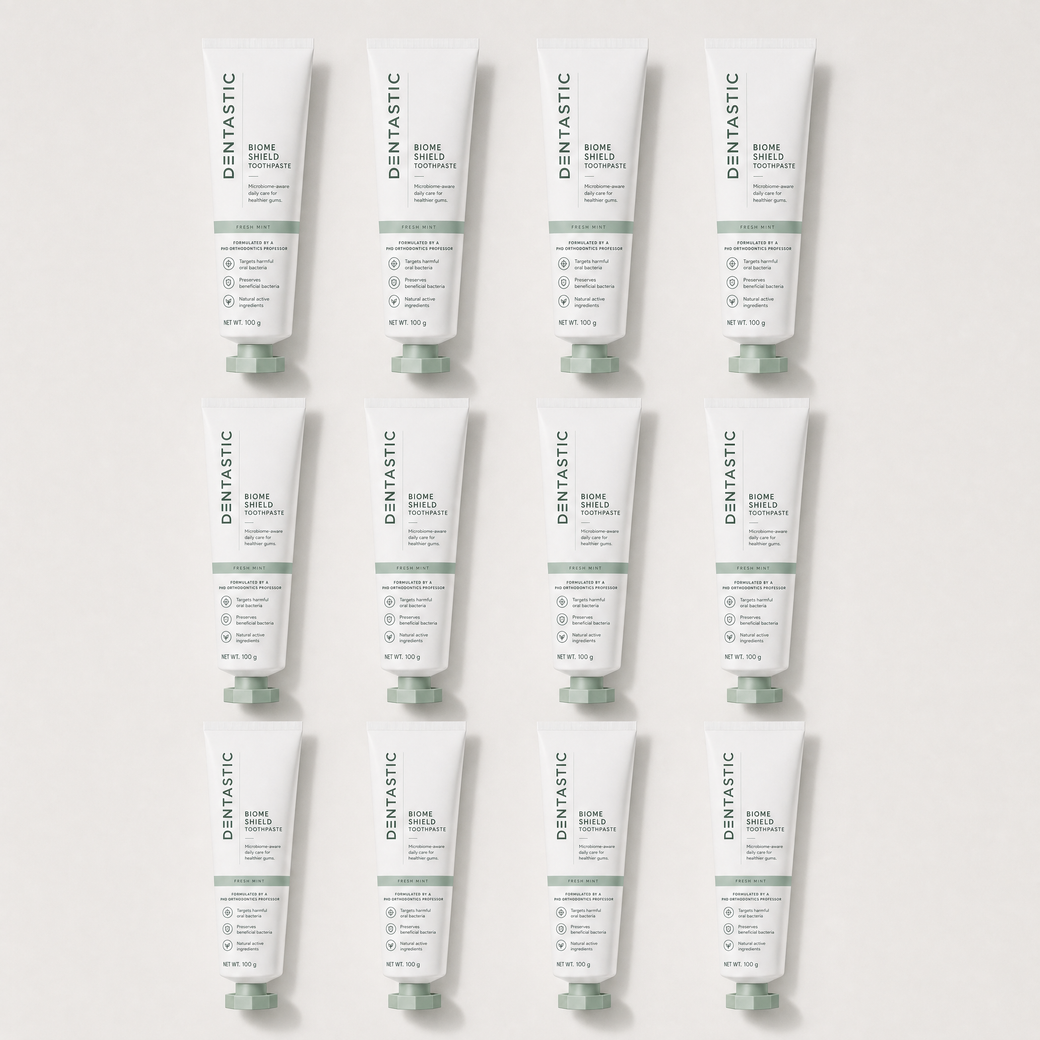
90-day money-back guarantee.
Unopened tubes can be returned within 90 days of delivery, in their original packaging, for a full refund of the product cost. Once a tube has been opened we can’t take it back — toothpaste is a hygiene product.
Reasonable questions, answered plainly.
Start where the problem actually is.
Free shipping on every order. No subscription, nothing to cancel, and 90 days to change your mind.
First order
Three cards, one welcome code. Enter your email, reveal your card, and we will send the same code to your inbox.
10% off the Restoration Package and the Lifetime Package · one use per customer